2004 QP
main belt asteroid discovered from La Cañada
2004.08.15
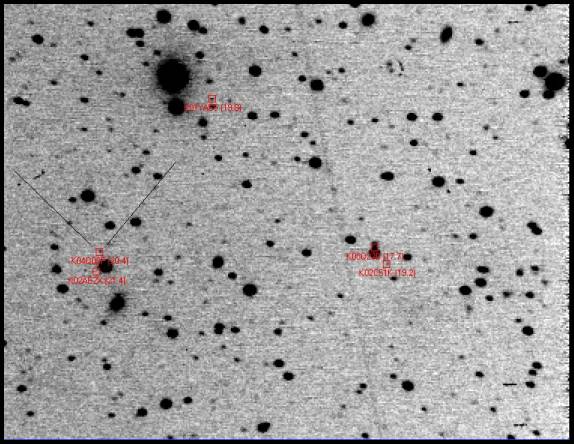
One of the stacked frames used for blinking in astrometrica (1). When I was working this field only three asteroids where plotted on the screen by the program. After the catalog update by the minor planet center, up to five asteroids are shown. The new asteroid, on the center left, is marked with two lines. Another three asteroids are visible in the image, the fourth one, next to and just below the discovery, was at magnitud > 21, beyond the reach of the telescope. A satellite trail can be seen crossing the image.
On follow
up observations of 2004 PP75 requested by Michel Ory the night of 2004 August
the 15th I was unable to find it but considering it was just a
Väisälä orbit I thought it could be in a nearby field. I moved the telescope a
little to the east and started a new series of pictures, after one hour
integration time some tiny objects started showing up in the blink window, some
of them were identified with known
objects while one of them remained unidentified.
I thought
it could be a new object and I logged into the minor planet center mpchecker
online service to check for possible candidates around the area but nothing was
there about, moving in a similar manner.
Then I sent
my astrometry to the center, after a while I got an e-mail from Gareth Williams
stating that one of the objects that I sent,
as identified with a known asteroid, didn’t fit well, this could be another new one I thought,
then I resent the astrometry for this object as unidentified.
The weather
was overcasting and I needed more observations, I talked to Rafael Ferrando
from observatory Pla d’Arguines (941), he is a very experienced observer and
has done many asteroid discoveries (65 by now) , Rafael told me he would try it
that same night if at all possible. I also requested follow up to Peter
Birtwhistle, running the Great Shefford Observatory (J95) and to Michel Ory.
Rafael
Ferrando detected both candidates just before the clouds covered the scene, he
sent the astrometry to the mpc, with a big note to make clear that in the case
of discovery credit should be given to
La Cañada, thanks very much indeed Rafa.
The next
day the mpc published the daily orbit update I saw that the observations of my
first candidate have been linked to an existing object 2001 YS106, it was quite
a surprise because it didn’t appear on the minor planet checker service. The
other object however, the one I thought was already catalogued and that Gareth
told me it didn’t fit well, was not linked yet.
I sent an
e-mail to Tim Spahr at the mpc asking for some clues, he told me that my
provisional designation was wrong ‘cause it was longer than six chars, I resent
the astrometry under a new, shorter, designation.
The next
night Rafael Ferrando was very kind to try it again. The mpc computed the
elements of the orbit and was published on the daily orbit update of 19.08.2004
with the designation 2004QP.
On 2004
August the 20th I received and e-mail from Peter with astrometry he
did on both objects, this will expand the observed arc to produce more accurate
orbital elements before the new object goes beyond the limits of our
telescopes.
This tiny
body has an absolute magnitude H=19.7, the derived size is in the 300-600 m
range.
Unfortunately,
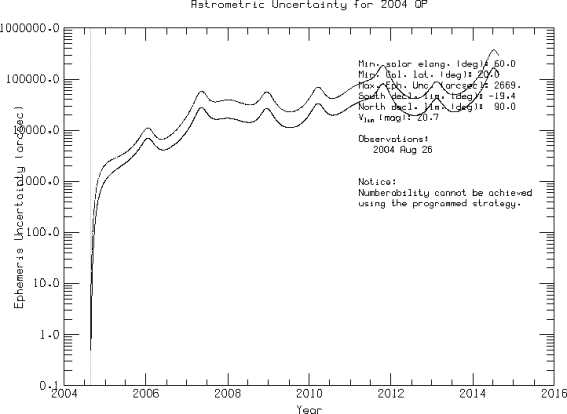
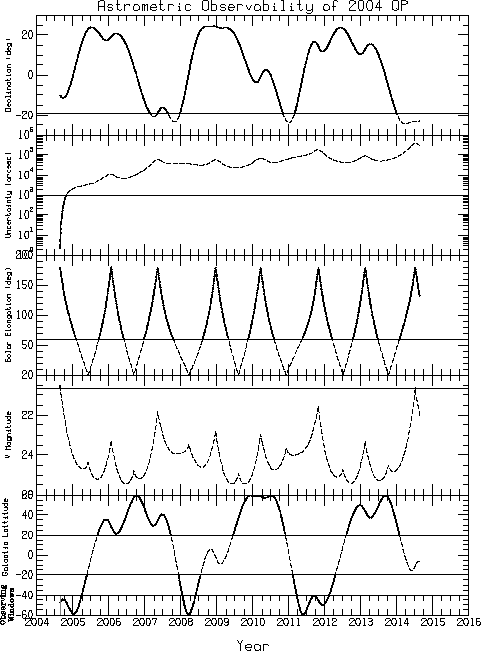
according to the Lowell Observatory online services, the object is so faint
that it will keep below mag 22 for many years on, unless some big telescope
catches it again in a few days time it will be lost.
Here
follows the first orbit computed by Ramon Naves with project Pluto’s FindOrb
based only on my first observations, it is apparent that these elements are for
a main belt asteroid.
Orbital elements:C40815A Perihelion 2004 Aug 16.040392 TTEpoch 2004 Aug 3.0 TT = JDT 2453220.5M 355.96153 (2000.0) P Q
n 0.30968913 Peri. 32.37542 0.83407635 0.55140639
a 2.1636419 Node 294.15251 -0.50987005 0.75924827
e 0.2138255 Incl. 1.02726 -0.21059237 0.34567765
P 3.18 H 19.9 G 0.15 q 1.7010000From 6 observations 2004 Aug. 16-16; RMS error 1.041 arcseconds
Below is the first orbit from the
minor planet center,
2004 QP
Epoch 2004 Aug. 3.0 TT = JDT 2453220.5 MPCM 359.72685 (2000.0) P Q
n 0.28232794 Peri. 24.65060 +0.78002928 +0.62547360
a 2.3012659 Node 296.61986 -0.57746142 +0.70823154
e 0.2219780 Incl. 1.17677 -0.24102412 +0.32740015
P 3.49 H 19.7 G 0.15From 21 observations 2004 Aug. 16-18. Residuals
20040816 *J87 0.1- 0.1- 20040817 941 0.4- 0.1- 20040818 941 0.1+ 0.2-20040816 J87 0.1+ 0.1- 20040817 941 0.1- 0.1- 20040818 941 0.2- 0.1-20040816 J87 0.5- 1.3+ 20040817 941 0.1- 0.1+ 20040818 941 0.1- 0.0+20040816 J87 0.5+ 1.9- 20040817 941 0.1+ 0.0 20040818 941 0.1+ 0.1+20040816 J87 0.4- 0.7+ 20040817 941 0.1+ 0.5+ 20040818 941 0.0- 0.1-20040816 J87 0.2+ 0.1+ 20040817 941 0.1- 0.5+ 20040818 941 0.1+ 0.1-20040816 J87 0.4+ 1.1- 20040817 941 0.0+ 0.6+ 20040818 941 0.1+ 0.1-
After some more observations were
added the orbit doesn’t change much,
2004 QP
Display all designations for this object
Epoch 2004 Aug. 3.0 TT = JDT 2453220.5 MPCM 356.23508 (2000.0) P Q
n 0.26451822 Peri. 29.46451 +0.84278513 +0.53788466
a 2.4034347 Node 297.98256 -0.49812492 +0.76546847
e 0.2215925 Incl. 1.28684 -0.20392346 +0.35318283
P 3.73 H 19.4 G 0.15From 28 observations 2004 Aug. 16-20. Residuals
20040816 *J87 0.2+ 0.2- 20040817 941 0.0+ 0.1+ 20040818 941 0.2+ 0.1+20040816 J87 0.4+ 0.2- 20040817 941 0.0+ 0.6+ 20040820 J95 1.0+ 0.8+20040816 J87 0.3- 1.2+ 20040817 941 0.2- 0.6+ 20040820 J95 0.1- 1.4-20040816 J87 0.7+ 2.0- 20040817 941 0.1- 0.8+ 20040820 J95 0.7- 3.0-20040816 J87 0.5- 0.6+ 20040818 941 0.2+ 0.1+ 20040820 J87 0.7- 0.6+20040816 J87 0.0+ 0.1+ 20040818 941 0.1- 0.1+ 20040820 J87 2.6- 0.9+20040816 J87 0.1+ 1.1- 20040818 941 0.0+ 0.3+ 20040820 J87 1.8+ 0.3+20040817 941 0.4- 0.1+ 20040818 941 0.2+ 0.3+ 20040820 J87 1.1+ 0.1+20040817 941 0.2- 0.0+ 20040818 941 0.1+ 0.1+20040817 941 0.2- 0.2+ 20040818 941 0.2+ 0.1+
http://cfa-www.harvard.edu/mpec/K04/K04Q19.html
The Lowell Observatory services
report the following :
Asteroid Observation Strategy Chart
Builder
Strategy cannot be calculated.
An observing strategy for 2004 QP
cannot be computed because we are unable to compute the asteroid's covariance
matrix. This condition arises either when the asteroid's differentially
corrected orbital elements cannot be computed (an eccentricity-assumed orbit is
listed in astorb.dat) or, more likely, when we do not have a complete
astrometric data set. The covariance matrix is required to compute the
ephemeris uncertainty, and hence the observational strategy.
(1)
astrometrica
is an excellent program by Herbert Raab with functionality to track and stack
images allowing modest size telescope to reach very faint bodies provided
enough integration time is available. http://www.astrometrica.at
Thanks to the minor planet center, Gareth
Williams and Tim Spahr, thanks to the Lowell observatory for the online
services, thanks to Herbert Raab for astrometrica, thanks to Rafael Ferrando,
Peter Birtwhistle and Michel Ory for their effort in observing and thanks to Ramón
Naves for his first calculation of the orbital elements.